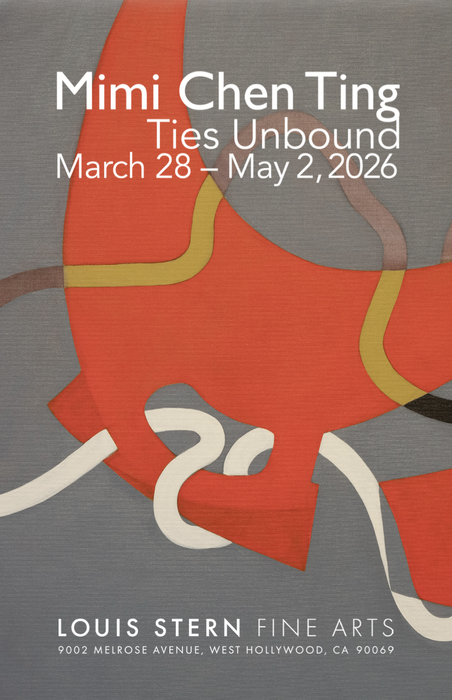
Mimi Chen Ting: Ties Unbound traces the stylistic evolution of Chinese American artist Mimi Chen Ting (1946-2022) from semi-autobiographical figuration to fluently expressive abstract painting. The artist’s reflections on her experiences as an immigrant, woman, and creative spirit remained a recurring theme as her approach shifted from the early 1990s to late 2000s. Ting visualized the conflicting obligations and enmeshments of identity, duty, and longing in the form of sinuous, intertwined cords. They evoke blood vessels or bindings, weaving throughout her paintings with equal capacity to strengthen, connect, or confine.
Ting felt a profound connection with her Chinese grandmother, whose bound feet shrunk her world as much as Ting’s audacious spirit broadened her own. In her earlier paintings, the artist explored her struggle to balance the competing forces of traditional expectations and the responsibilities of family life with her need for freedom and creative expression. Her 1999 painting Folded Woman contorts its subject’s lower body into a pinched, warped lotus position, even as a single defiant foot manages to wriggle free. Origins, 1991 depicts a fetal figure tumbling to earth from a vast primordial cosmos, cinched and tugged in opposing directions by a looped length of cord that crosses at its navel. The serene figure in Sleeping Woman, 1996 is suspended from a single rope slung around her waist, a painful pressure point that nonetheless supports her weight.
In the following decade, Ting distilled these contemplations into the meandering abstract forms of her Tangles and Ties series. “It’s a fear of being bound,” she mused in a 2021 interview, “that’s behind everything I do.” True to this impulse, the colorful ribbons that twist dreamily through the nebulous feathered space of these paintings stubbornly assert their independence. They overlap but never truly touch as they loop, entwine, and curl themselves into fragile knots, with ends left dangling loose for a quick escape. Ting’s bright threads knit themselves into flowing maps of life’s unpredictable paths, obstinately self-reliant but irresistibly transformed by the entanglements they encounter along the way.
Works by Mimi Chen Ting have been exhibited throughout the United States and internationally, including a 2023 career survey presented by University Art Gallery, Sonoma State University and the retrospective exhibition Mimi Chen Ting: Make Movement Visible, on view at the Brigham Young University Museum of Art from April 10 – October 10, 2026. She received a National Endowment for the Arts Grant in 2003 and the Agnes Martin Award for Abstract Painting and Drawing in 2012. Her work can be found in numerous private, corporate, and public collections, including the Annie Wong Art Foundation, Hong Kong; the Harwood Museum of Art, Taos, New Mexico; and the BYU MOA, Provo, Utah.